
Summary
This article explores the intersection of Black and disabled identities through an interview with MJ, a Black disabled woman who shares her experiences with racism, ableism, healthcare discrimination, identity, and community. Her story highlights the importance of representation, disability justice, and creating spaces that center the voices and lived experiences of Black disabled individuals.
I’m Also Here: Exploring the Intersection of Black and Disabled Identities
By Kris Johnson – Intern at disAbility Law Center of Virginia (dLCV)
Approximately one out of four individuals who identify as Black also identify as living with a disability. Historically, Black disabled individuals have not been afforded the same privileges as white disabled individuals when navigating various aspects of society. A significant contributor to the barriers Black disabled individuals face is, unsurprisingly, racism. At the same time, ableism further restricts access to opportunities, resources, and support. Vilissa Thompson, a Black disabled social worker and activist, highlights this intersection, stating, “… our concerns are rarely prioritized by other movements because people fail to see how our lives are impacted by white supremacy and ableist culture…we can’t have our race or disability take a backseat because fragmenting our identity means we are not seen.” Black disabled individuals are often overlooked or excluded from broader conversations about race and disability. To address this gap and center the lived experiences of Black disabled individuals, I had the opportunity to sit down with MJ, a Black disabled woman with non-apparent disabilities, and listen to her experiences navigating the intersection of these identities.
- Question: How has being Black shaped your life experiences?
MJ: Being Black American has always been something I’ve been proud of, but I also learned pretty early on that my identity comes with a lot of complexity. Growing up as a disabled Black person taught me a lot about the interdependence within the Black community and the resilience that’s been birthed from generations of oppression. As I’ve gotten older, I’ve become more grateful for those who came before me. Many aspects of my advocacy journey have been mirrored by leaders like Fannie Lou Hammer, Brad Lomax, and Audre Lorde.
- Question: How has your disability shaped your life experiences?
MJ: Having multiple conditions, many aspects of my disabilities appeared in early childhood. For a long time, I had a lot of internal conflict with identifying as “disabled” because of how others perceived me. After years of attempting to hide my disability, I finally found my voice. I began using the term disabled, I found community, and a deeper sense of self, which has provided more meaning to my life.
- Question: How do these two identities intersect for you?
MJ: Being someone who is multi-marginalized, finding more about yourself or adopting new identities can feel isolating. Growing up, I experienced isolation a lot because many of my friends were generally non-disabled. Finding folks who are both black and disabled is a shared experience that many can not understand unless from lived experience. For me, my black identity has taught me a lot about standing in my truth, being disabled has offered me the ability to speak clearly about my needs.
- Question: Have there been moments when you felt misunderstood because you’re Black and disabled?
MJ: Yes, all the time, I have a lot of medical PTSD due to medical racism, provider bias, and traumatic procedures/surgeries without proper care of my needs. I am often having to share not only my experience and symptoms but also prove why I am deserving of care. It has probably taken me over fifteen years to find my current team of providers who not only listen to my concerns but provide choice and autonomy. I am often written off, unheard, or expected to figure out how to manage everything alone.
- Question: Where have you found the greatest sense of community?
MJ: When I first began searching for a community, I found it virtually. Social media has provided me with friends across the globe, creating lifelong bonds and also granting me the opportunity to meet others who have a shared experience. Growing up with multiple health conditions was incredibly isolating, but being able to find people who have endured similar experiences is huge and social media provided a wider range of people to meet who aren’t just in my local community.
- Question: What brings you joy?
MJ: Honestly, seeing my loved ones happy brings me so much joy. Finding new hobbies or even trying new things with those I care about always brings me joy.
- Question: What changes would you like to see for Black individuals who are disabled?
MJ: Honestly, I think there needs to be more space to speak about the worries, experiences, and discomforts that come along with being black and disabled. For example, often in disability justice spaces people share their experiences, but the racism or racial trauma in healthcare differs from the general systemic issues. There should be room to explore and identify the root cause of those issues.
I appreciate the opportunity to sit with MJ and listen to her experiences as a Black disabled woman. Too often, the experiences, perspectives, and contributions of Black disabled individuals are overlooked, minimized, or erased, allowing dominant white narratives to remain centered. MJ’s words challenge this erasure by highlighting the presence, resilience, and contributions of Black disabled individuals within these spaces. She also brought attention to the need for more spaces where the root causes of worries, experiences, and discomforts that Black disabled individuals endure can be acknowledged and addressed. Moving forward, it is essential that voices of Black disabled individuals remain a priority in conversations about disability, race, access, and social justice.
Ashley Mendez
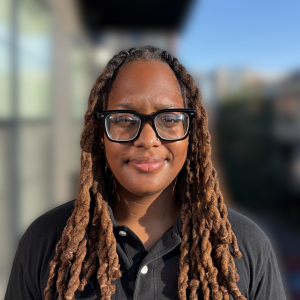
Kris (she/her) was a summer intern at dLCV while completing her Master of Social Work, specializing in clinical practice. She appreciated her time as dLCV as she gained a new perspective of the social work practice. Kris enjoys being outside, learning new hobbies, and hanging with friends.
“
“dLCV is a 501(c)3 nonprofit that provides information and referral, legal representation, technical assistance, short-term assistance, systemic advocacy, monitoring and training to Virginians with disabilities. Our services are provided free of charge. We are independent from state and local government.
The statements given by staff or volunteers for our blog content are NOT intended to be taken as legal advice. Instead, our blog content aims to focus on the lived experiences of people with disabilities and shine a light on the diverse perspectives within Virginia’s vibrant disability community.”
— dLCV Blog Content Statement